More than half of active US travellers now use AI to plan, book or navigate a trip, up from a third in early 2025. For operators this changes how a stay or an experience gets found, and which ones get recommended.
Adoption is moving fast, led by younger travellers
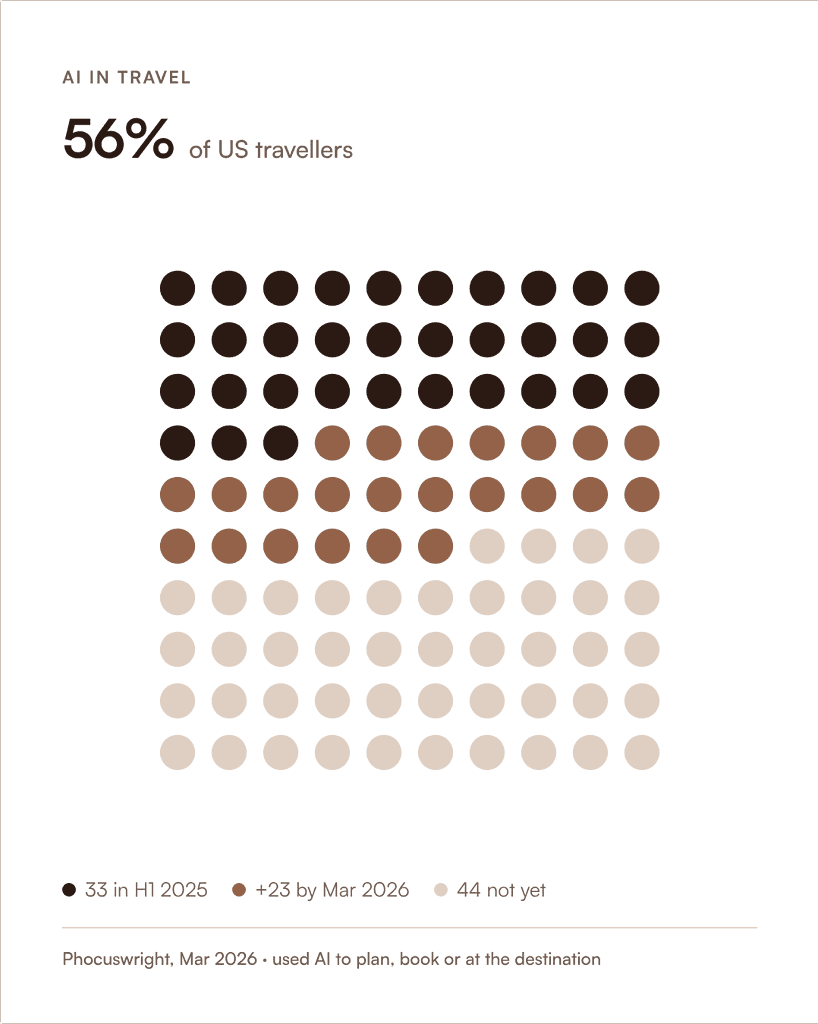
Phocuswright calls AI the fastest behavioural shift in travel in a decade. In March 2026, 56% of active US travellers said they had used AI in the past 12 months to plan a trip, book it or get help at the destination.
That share was 43% in the second half of 2025 and 33% in the first half of 2025 (PhocusWire, March 2026). More than half of AI users still click through to source websites after seeing an AI answer.
The July 2026 update shows where the use is heading (Phocuswright, July 2026):
- 33% of US travellers use generative AI platforms such as ChatGPT for trip research, about five times the 2024 level.
- 74% of millennials and 72% of Gen Z used AI for at least one trip in the past year.
- 44% would book directly inside an AI platform, and 40% would let an AI assistant handle flight and hotel bookings for them. Both figures are up on the year before.
Planning is already AI-led, booking comes next
AI use is strongest at the start of the trip, when guests research and compare. Willingness to hand over the booking is growing but varies by market:
- More than half of travellers across 14 countries said they were ready for AI agents to plan and book whole trips
- Among AI users in a TakeUp survey of 300 US travellers, 94% trust AI travel recommendations at least as much as other sources
The Nokken Hospitality Trend Report 2026 (Trend 04, Intelligent Advantage) describes the direction. Travellers describe a trip in plain language, such as a quiet coastal weekend with design-led interiors, great coffee and local walks, and an assistant returns tailored options within seconds.
Mindtrip is one example: its conversational assistant plans and books trips, hotels have been able to place it on their own websites since late 2025, and The Bahamas has partnered with it to turn inspiration into itineraries across 16 islands.
Measures of clicks disagree. Phocuswright finds that half of AI-search users still click through to source websites, while Mario Gavira of Travelier, put the share of people who click no link after a chatbot answer at 99.5%. Both can be true for different tools and different stages, so a website still matters, but fewer visits will come from a plain search result.

What makes an assistant recommend a stay
I found no public data on how AI assistants rank individual properties. What exists is practitioner advice and a few survey results, summarised below. The shared message is that an assistant recommends what it can understand and verify.
Make the shortlist first
Travel brands are moving from search engine optimisation to generative engine optimisation (GEO). AI rarely names brands early in the journey, so the first goal is to be included among the options, then to shape how the model describes you through content, including on third-party sites (PhocusWire, 2026).
Cover the whole question
AI splits a request into several sub-queries, so content needs to answer the range of intents behind it, not a single keyword (PhocusWire, 2026).
Consistent, verifiable facts
Hotels need clear, structured, consistent and verifiable information across their own site, OTAs, Google Business Profile and destination platforms. Fragmented content risks dropping out of AI discovery (HES-SO Valais-Wallis, 2026).
Structured, conversational content
Schema.org markup, FAQs, tables for rules and amenities, and unique features written in natural phrasing. This is the authors’ opinion and is untested (Hospitality Net, 2025).
Brand and voice
Well-structured content, strong imagery, detailed descriptions and a distinct brand voice are the data points that power discoverability (Nokken Hospitality Trend Report, 2026).
What guests act on
Of the AI recommendations travellers act on, price comparisons lead (44%), then summarised reviews (33%) and recognised brands (32%) (Phocuswright, 2026).

A checklist for smaller brands
Two points stand out for small operators. First, Skyscanner’s Piero Sierra named general brand investment as the biggest driver of AI visibility, which makes a clear, consistent story about what the place is the base for everything else.
Second, Demand-Genius CEO Tom Rudnai advised smaller brands to pick a specific starting point, target segments and a few channels instead of matching large players everywhere. A distinct concept such as a wood-fired sauna cabin in the forest is easier for a model to place than a generic cottage.
The steps below are my synthesis of the sources above, ordered from quick to demanding.
1. Describe the place in plain language. Say what it is, how far it is from the nearest city, what is included and who it suits, in the words a guest would type, for example “off-grid cabin with a wood-fired sauna, two hours from Helsinki”.
2. Keep the facts identical everywhere. Name, location, capacity, prices, rules and amenities should match on the own website, Google Business Profile, OTAs and destination sites.
3. Answer the practical questions in a clear format. An FAQ and short tables for check-in, sauna heating, pets, access and season help assistants (and guests) find the answer.
4. Add structured data. Schema.org markup for the lodging, with current availability and prices where possible, makes the content easier for machines to read.
5. Collect recent reviews and show them. Summarised reviews are among the things guests act on in AI recommendations (33%).
6. Get mentioned elsewhere. Destination organisations, local partners and press give models more places to find and confirm the story.
7. Test it every quarter. Ask ChatGPT, Gemini and Claude the questions guests would ask, note how the place is described and fix the gaps.
Sources
Grand View Research, 2026. Glamping Market press release.
HES-SO Valais-Wallis (Roland Schegg, Jean-Claude Morand), 2026. Be visible to AI: the keys to semantic optimization and GEO for hotels.
Hospitality Net, 2025. From Keywords to Conversations: The Ultimate Guide to Generative Search for Hotels.
Hotel Management Report 2026. AI-planned travel surges in 2026, growth still ahead.
Nokken Field Report, 2026. Hospitality Trends 2026.
PhocusWire, 2025. Global study finds majority of travelers ready for AI to book trips.
PhocusWire, 2026. The fastest shift in travel behavior just became the default.
PhocusWire, 2026. Travel marketers look to improve AI visibility and prepare for agentic booking.
Phocuswright, 2026. The AI sure hits its stride: 5 takeaways for travel leaders from the report The AI Surge: Travel’s Fastest Behavioral Shift in a Decade.